
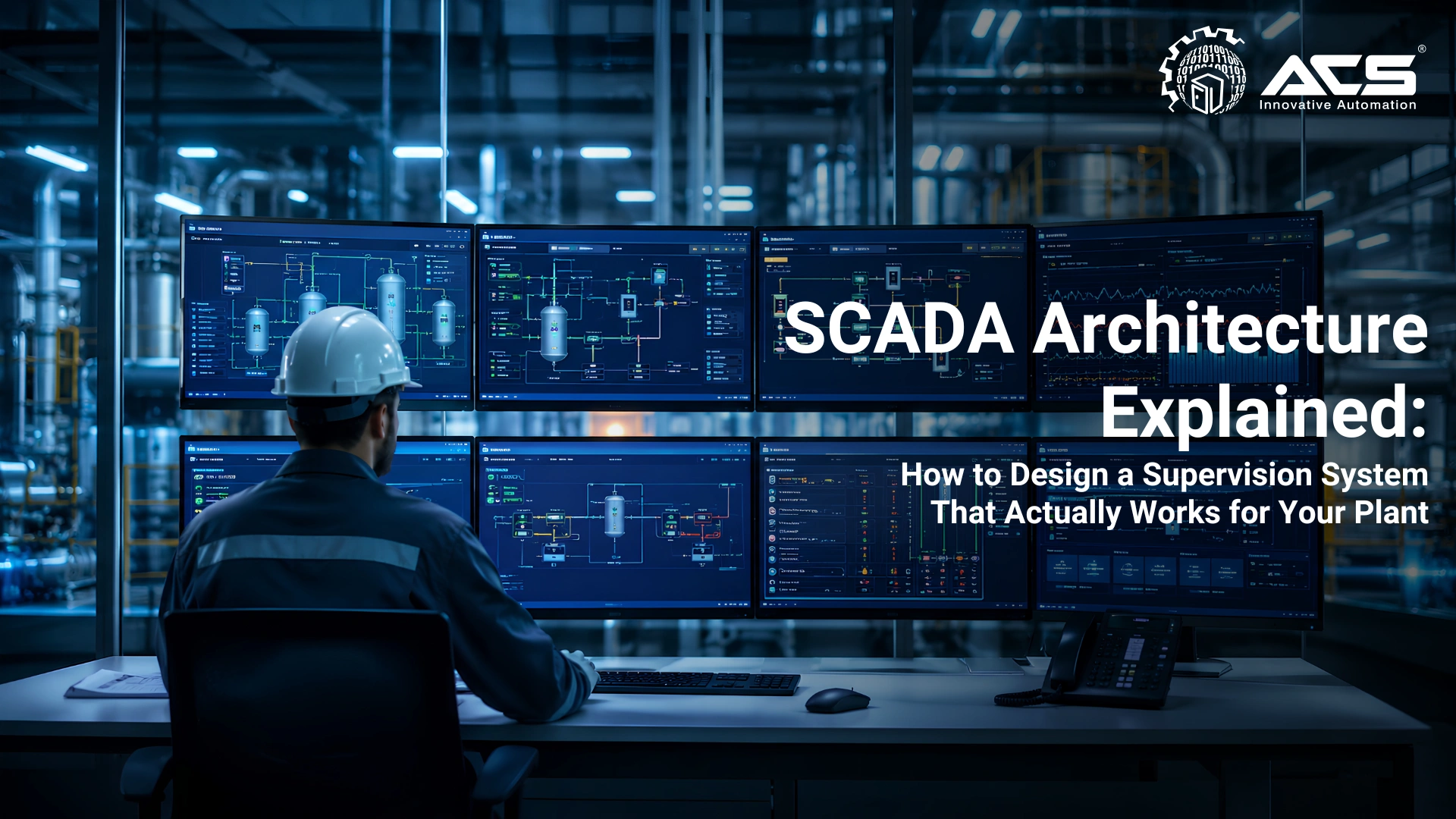
SCADA Architecture Explained: How to Design a Supervision System That Actually Works for Your Plant
When it comes to industrial SCADA architecture, what SCADA Is, and What It Is Not
SCADA stands for Supervisory Control and Data Acquisition. The name precisely describes its three functions:
- Supervisory Control, providing operators with the ability to issue commands to the process from a central location
- Data Acquisition, collecting real-time process data from field instruments, PLCs, and drives via industrial communication networks
- (Implied) Visualization and Alarming, presenting collected data to operators in a structured, actionable format
What SCADA is NOT: a replacement for the PLC. The PLC executes control logic autonomously at the field level, typically at scan rates of 1–100 milliseconds. SCADA communicates with the PLC at longer intervals (typically 100–1000 milliseconds) and provides supervision, not real-time control. Safety critical functions must never depend solely on SCADA.
The ISA95 Automation Pyramid: Where SCADA Sits
| Level | Function and Systems |
|---|---|
| Level 4, Business Planning | ERP: SAP, Oracle; production scheduling, procurement, supply chain |
| Level 3, Site Operations (MES) | Manufacturing Execution System: production tracking, quality management, OEE reporting |
| Level 2, Supervisory (SCADA) | SCADA, HMI, Historian, Alarm Management, this is where plant operators work |
| Level 1, Control | PLCs, DCS, PID controllers, Realtime closed loop control |
| Level 0, Field | Sensors, transmitters, actuators, drives, motors, physical process |
| A well-designed SCADA system sits at Level 2 and interfaces both downward (to PLCs via industrial protocols) and upward (to MES or ERP via OPCUA or REST APIs). | Communication Architecture: How SCADA Talks to the Plant |
| OPC UA: The Modern Standard (IEC 62541) | OPC UA (Open Platform Communications, Unified Architecture) is the current industry standard for secure, platform independent communication between industrial devices and SCADA systems. It replaces older OPC Classic (DCOM based) with a service-oriented architecture that works across operating systems and networks without Windows specific dependencies. |
| Key OPC UA characteristics: | • Information model: data is structured as a semantic hierarchy (nodes, variables, methods, events), not just raw tag values |
- Security: certificate-based authentication, signing, encryption, and role aware access when supported and correctly configured
- Transport: TCP (binary, high performance) or HTTPS (firewall friendly)
- Many S71500 CPUs support an integrated OPC UA server, subject to CPU capability, firmware, licensing, and project configuration
Legacy Protocols Still in Common Use
| Protocol | Application in SCADA |
|---|---|
| PROFINET | Realtime industrial Ethernet for controller, distributed I/O, drives, and field devices; SCADA connectivity normally uses supported S7, OPC UA, or other application protocols |
| Modbus TCP | Universal; used for third-party meters, drives, and instruments with SCADA |
| PROFIBUS DP | Older fieldbus; still present in plant expansions with legacy S7300/400 PLCs |
| USS Protocol | Siemens serial protocol for drive parameter reading/writing in SCADA |
| IEC 608705104 | Telecontrol protocol; used in SCADA for remote substations and power systems |
Core SCADA Software Functionality
Process Mimics and Graphics
The operator interface of a SCADA system is built around P&ID style process mimics, graphical representations of the plant showing equipment, valves, instruments, and flow paths. Good mimic design (covered separately under High Performance HMI) is as important as the underlying communication architecture.
ACS Engitech develops SCADA graphics on Siemens WinCC Unified/Professional/V8, a widely used SCADA platform for Siemens based automation systems. Mimics are developed with:
- Dynamic elements tied to live PLC tags: valve states, motor running/stopped, level indications, flow arrows
- Popup detail screens for individual equipment diagnostics
- Neutral normal state graphics with color reserved for alarms, faults, and important deviations, consistent with the project HMI philosophy
Alarm Management per ISA18.2
Alarm management is where most SCADA implementations fail in practice. Plants routinely experience 'alarm floods’, situations where hundreds of alarms fire simultaneously, overwhelming operators and making it impossible to identify the root cause.
The ISA18.2 standard (Management of Alarm Systems for the Process Industries) defines a rational approach:
- Alarm rationalization: every alarm must have a defined consequence, operator response, and maximum acceptable response time, 'alert without action' alarms are eliminated
- Alarm priority classification: typically, 4 levels (Critical, High, Medium, Low) tied to time to consequence
- Alarm shelving and suppression: planned maintenance or startup conditions may legitimately suppress certain alarms, documented and time limited.
- KPI monitoring: alarm rates, standing alarms, chattering alarms, and peak alarm floods are measured against the plant's approved alarm philosophy and recognized industry guidance
Where required, ACS Engitech can configure alarm history with time stamps, priority, acknowledgement information, and reporting in WinCC archives or an approved database architecture. Audit trail claims depend on the configured security, retention, and change control design.
Process Historian
A process historian stores high-resolution timeseries data from all plant instruments and PLC tags. Unlike a relational database, historian software is optimized for timeseries storage and retrieval , compressing data without losing resolution, supporting queries like 'show me pump flow rate for the last 30 days.'
Historian data enables:
- Root cause analysis: trace every process excursion back to the exact sensor reading, operator action, or equipment event that caused it
- Production reporting: automated batch reports, shift summaries, daily production logs
- Compliance support: retained process records can support audits and reporting when the system includes appropriate time synchronization, access control, retention, and data governance procedures
- Process optimization: long-term trend analysis to identify gradual degradation (fouling, wear, drift)
Siemens WinCC includes an integrated historian (WinCC Archive). For larger deployments, dedicated historian platforms such as iSOFT PI or Wonderware Historian are used.
SCADA Redundancy Architecture
For plants where SCADA downtime is unacceptable, continuous process industries, critical utilities, redundancy is designed into the SCADA server architecture:
| Configuration | Description |
|---|---|
| Single Server | Single SCADA server with UPS backup. Lowest cost. Acceptable for noncritical applications. |
| Hot Standby (Active Passive) | Primary server runs live; standby server maintains a mirrored database. On primary failure, the standby server takes over automatically according to the tested redundancy design. Standard for critical process plants. |
| Dual Active (Load Balanced) | Both servers active simultaneously; clients connect to either. Maximum availability. Used for large, multiclient SCADA installations. |
| Thin Client Architecture | SCADA server centralized; operators access via thin clients or web browsers. Simplifies client maintenance; all processing at server. |
Remote Access: Monitoring from Anywhere
Modern SCADA platforms support remote access for plant management, on call engineers, and support teams. ACS Engitech implements remote access exclusively via:
- Siemens Industrial VPN router (SCALANCE S series) or equivalent, creating an encrypted tunnel between the remote user and the plant network
- SCADA thin client web server, authorized users access the SCADA interface via a browser without a full client installation
- Role based access control, view only access for management, write access for control room operators, full engineering access for maintenance engineers
Critical requirement: Remote access must never bypass the plant's OT network security boundary. Direct internet facing SCADA connections are never recommended or implemented.
Conclusion: SCADA Is an Investment in Operational Intelligence
A well-designed SCADA system is not a display device. It is the primary interface through which plant management, operators, and engineers interact with the process, for control, for diagnostics, for compliance, and for optimization. Its architecture determines what information is available, how fast alarms are acted upon, and how effectively the plant's performance can be analyzed and improved.
Suggested social hashtags: #SCADA #WinCC #Siemens #OPCuA #AlarmManagement #Historian #IndustrialAutomation #ProcessControl #ACSEngitech
About ACS Engitech Pvt. Ltd.
Since 2009, ACS Engitech has delivered automation solutions across manufacturing sectors. As a Siemens Channel Partner, we provide comprehensive automation systems including PLC panels, SCADA implementation, and remote monitoring solutions. Our 6000 sq. ft. manufacturing facility in Ahmedabad serves clients across India with ISO 9001-certified control panel solutions.
Take Action Today
Ready to optimize your facility? Connect with us to discuss how automation can improve your operations and address critical demands.
Connect With Us